Tucker's Kremlin Karaoke: Pro-Putin Talking Points, Zero Explanations.
A systematic review of Carlson's most damaging broadcasts -- from defending Putin's invasion to amplifying FSB disinformation
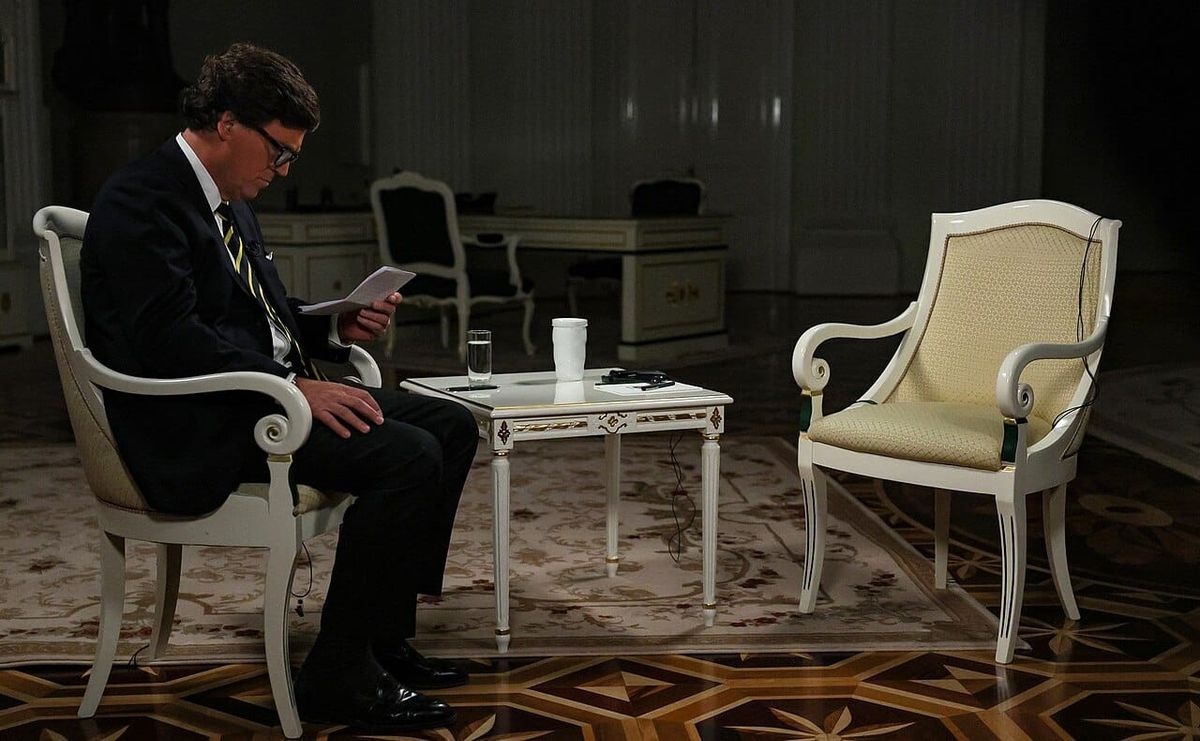
A systematic review of Carlson's broadcasts reveals a years-long pattern of alignment with Russian state media narratives. Whether that pattern reflects coordinated intent, ideological sympathy or simple opportunism, the questions it raises have never been satisfactorily answered.
In February 2024, Tucker Carlson traveled to Moscow to conduct what he billed as a groundbreaking interview with Vladimir Putin. What followed was widely criticized as a propaganda exercise. Carlson asked no challenging questions, accepted Putin's disputed historical claims without pushback and returned to the United States to describe the Russian capital as cleaner and better-run than American cities. For anyone who had been paying attention to Carlson's broader trajectory, it was the logical culmination of a years-long pattern.
200 Talking Points and Counting
Analyses by organizations tracking disinformation, including the Alliance for Securing Democracy and the Institute for Strategic Dialogue, have documented repeated instances of Carlson's content being amplified by Russian state media outlets including RT and Sputnik. Kremlin internal directives from 2022, reported by Mother Jones, explicitly instructed Russian state outlets to feature Carlson's broadcasts heavily, particularly those criticizing NATO expansion, U.S. involvement in Ukraine and Western institutions.
The topics covered a range of issues central to Russian strategic messaging: Ukraine's legitimacy as an independent nation, NATO's role in European security, the trustworthiness of American intelligence agencies and the corruption of Western democratic institutions. On each of these, Carlson's commentary tracked closely with the messaging coming out of Moscow.
Carlson has consistently maintained that he is asking legitimate questions ignored by mainstream outlets and that his positions reflect an America First skepticism of neoconservative foreign policy, not any sympathy for Russia. That framing deserves to be taken seriously. It does not explain the full pattern.
Ukraine
Carlson's coverage of Ukraine provides the most documented examples of alignment with Kremlin narratives. He repeatedly characterized the Ukrainian government as a corrupt puppet regime, questioned NATO expansion as a provocation and amplified unverified Russian claims about Ukrainian bioweapons laboratories, a conspiracy theory that originated with Russian military intelligence and was designed to justify the invasion. AP and Reuters fact-checks found no credible evidence supporting those claims.
On the Nord Stream pipeline explosion, Carlson promoted the suggestion that the United States was responsible, a narrative that originated with Russian intelligence services and was echoed directly by Putin during their interview. Carlson framed it as simply asking questions. The questions he asked pointed consistently in one direction.
The Moscow Interview
The Putin interview itself ran for over two hours. Putin delivered an extended historical lecture presenting selective and disputed claims about Russia-Ukraine history to justify the invasion. The full transcript is publicly available on the Kremlin's own website. Carlson did not challenge Putin on political repression, jailed dissidents, murdered journalists or civilian casualties in Ukraine.
Russian state media celebrated the interview as a propaganda success, using clips extensively in domestic messaging for months afterward. Whatever Carlson's intentions, the result was a significant gift to a hostile foreign government's information operation.
Upon returning, Carlson praised Moscow's infrastructure and order in terms that drew widespread criticism from across the political spectrum, including from conservatives who supported his broader skepticism of U.S. foreign policy.
Guest Associations
In the months following the Moscow interview, Carlson's program featured guests whose views aligned closely with Russian strategic perspectives, some of whom had faced U.S. government scrutiny for ties to influence networks. Several individuals who appeared on his platform have since been sanctioned by the U.S. Treasury Department for involvement in Russian influence operations. Carlson has defended his booking decisions as open discourse and a willingness to platform voices excluded from mainstream media.
The Open Question
The pattern does not prove coordinated intent. Carlson has denied being pro-Russian and has framed his positions as principled opposition to American interventionism. Those are positions held by many conservatives who have no connection to Russian influence operations whatsoever.
What the pattern does establish is that Carlson's content has functioned, consistently and over years, as a force multiplier for Russian state messaging in the American media environment. Whether that reflects deliberate alignment, ideological sympathy, commercial incentive or unconscious bias toward narratives that generate the most engagement is a question Carlson has never addressed directly.
In an open U.S. media system, foreign adversaries actively seek out domestic voices whose content serves their strategic interests, whether those voices are willing participants or not. The Carnegie Endowment and academic researchers studying foreign influence operations have documented how this amplification works: state-linked networks identify content that serves their goals and boost it, regardless of the original intent behind it.
Conservative audiences deserve voices that question U.S. foreign policy rigorously and independently. The question worth asking about Carlson is not whether he is allowed to be skeptical of American institutions. He clearly is. The question is whether the specific shape of his skepticism, its remarkable consistency with Kremlin priorities, its enthusiastic reception by Russian state media, its timing around key geopolitical moments, reflects something more than coincidence. That question remains open. It deserves a better answer than it has received.
Comments ()