The Invisible Hand in American Politics
A California tech executive went from $15 in lifetime political donations to $1 million in a single wire transfer. The money traces back to a Chinese state-linked deal the U.S. government already tried to kill.
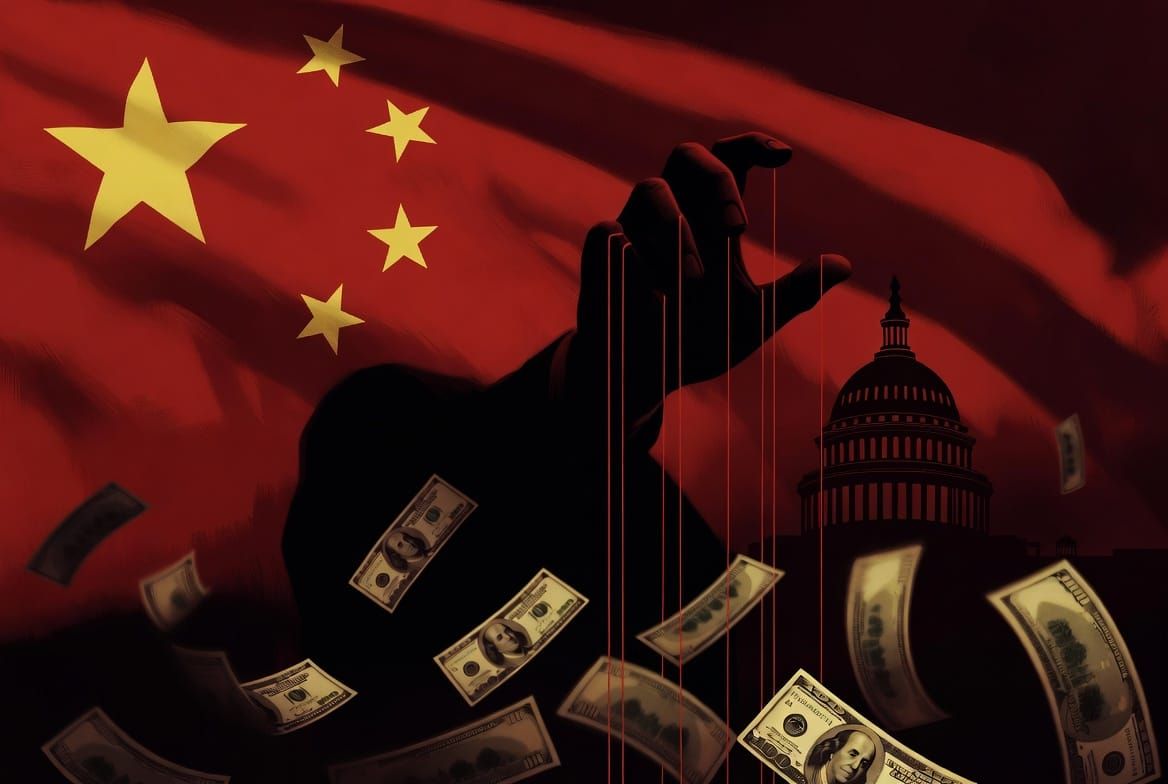
How Chinese state-linked capital flagged as a national security threat found its way into American congressional races.
A few years ago, independent journalist Lauren Southern was approached by a contact who offered her a story. He wanted her to travel to the Donbas region of Ukraine and document what he described as the oppression of the Russian people there, and why Russia had a right to defend them. He offered military contacts. It seemed like exactly the kind of access an independent journalist chases. She passed on it.
Three years later, Russia invaded Ukraine on that precise narrative. A year after that, the man who had pitched her the story was outed as a Chinese spy.
"I could have easily gone and made a documentary on the Donbas without thinking there was a single nefarious hand involved," Southern said in a recent interview.
That's the thing about Chinese influence operations. They don't arrive labeled. They look like a business contact, a soiree introduction, an organic opportunity – sometimes Russian-themed, sometimes wrapped in the language of social justice or tech investment, but with a Chinese hand behind it. And by the time anyone can prove it, the narrative is already made, distributed, and absorbed.
That's the method, which not only plays out in Moscow hotel lobbies, but in Silicon Valley boardrooms and in New York City politics, with the same deliberate distance from Beijing maintained at every step. Follow the money, and it traces back to exactly the kind of Chinese state-linked capital the U.S. government already tried to stop.
One Day After Mamdani Takes Office
Zohran Mamdani was sworn into office on January 1, 2026. One day later, on January 2, a new super PAC called American Priorities (FEC ID: C00932723) was registered. The mayor's race was the proof of concept. The PAC was the expansion.
Seeded by the same donor network that had funded Mamdani's rise, American Priorities immediately set its sights on federal congressional seats. As of June 3, 2026, per FEC filings, it had raised $5.5 million and spent $4.2 million on independent expenditures, nearly all of it on digital and television advertising targeting races across New York, New Jersey, North Carolina, and California. The candidates it backed were unified by one thing: alignment with Mamdani.
The spending breakdown is specific. Adam Hamawy, who won New Jersey's 12th Congressional District primary, received $1.5 million in ad support across three separate buys. Nida Allam in North Carolina received roughly $1.1 million. Darializa Avila Chevalier, who ousted a five-term incumbent in New York's 13th district, received $250,000 in support while the PAC spent another $250,000 opposing her incumbent. Christopher Rabb in Pennsylvania received $455,000. One FEC line item stands out beyond the dollar amounts: a February 10 entry for Allam is logged as "IN-KIND FROM JUSTICE DEMOCRATS PAC," a direct confirmation that American Priorities was not operating as a standalone entity but as part of a formally coordinated political network.
The PAC's single largest individual donor was Omer Hasan, a former executive at Silicon Valley tech company AppLovin based in California. His FEC contribution history tells its own story. Between 2019 and 2020, Hasan's entire federal political giving record consisted of small ActBlue donations – $1 here, $3 there, totaling roughly $15. Then, on December 30, 2025, the day Mamdani's transition to power was underway, Hasan donated $3,500 to Nida Allam in North Carolina twice on the same day. On January 16, 2026, he wired $1 million to American Priorities. In March, he gave $3,500 directly to Darializa Avila Chevalier's congressional campaign. Every recipient was a Mamdani-aligned candidate in a race the PAC was simultaneously flooding with ad spending.
The question worth asking isn't whether Hasan broke the law. He almost certainly didn't. He's an American citizen making legal political donations. The question is where his wealth came from and what the U.S. government had already said about that.
Follow the Money Back
In September 2016, AppLovin agreed to sell a majority stake to Orient Hontai Capital, a Chinese private equity firm and subsidiary of state-connected Orient Securities, for $1.4 billion. The deal never closed.
The Committee on Foreign Investment in the United States (CFIUS), the federal body charged with reviewing foreign acquisitions on national security grounds, intervened. The concern was Chinese state-linked ownership of AppLovin's massive trove of American user data. CFIUS killed the controlling stake, and the deal was restructured: Orient Hontai retained a 9.98% equity stake and converted the remainder into $841 million in debt financing. The capital didn't leave. It stayed embedded inside AppLovin as the company's valuation exploded and it eventually went public in 2021.
Orient Group, the parent company of Orient Hontai, was under formal investigation by China's own securities regulator from June 2024 for suspected major financial fraud spanning four consecutive years, having falsely inflated revenue by more than 16.1 billion yuan across its 2020 to 2023 annual reports. By March 2025, the company had been fined, its actual controller handed a lifetime market ban, and additional penalties of 39 million yuan proposed. On April 30, 2025, Orient Group was formally delisted from the Shanghai Stock Exchange. The Chinese state-linked financial ecosystem that originated the AppLovin deal was built on fabricated numbers, and the U.S. government had already flagged the capital before any of that came to light.
The U.S. government looked at this deal and determined it was a national security risk. It blocked Chinese state-linked ownership of an American company's data infrastructure. And yet the capital, restructured and laundered through corporate growth and an IPO, produced the executive wealth now flowing into American congressional races. CFIUS blocked the front door. The money came in through the window anyway.
This Isn't One Guy
If this were an isolated case, you could call it a coincidence. It isn't.
Fox News published an investigation revealing that senior employees at three companies the Pentagon had just designated as "Chinese military companies," specifically Alibaba, Baidu, and BYD, donated roughly $2.6 million to Democratic political committees since 2020. The recipients include Sen. Adam Schiff, Rep. Nancy Pelosi, former President Joe Biden, former Vice President Kamala Harris, Gov. Gavin Newsom, and the Democratic National Committee (DNC).
The Pentagon's Chinese military company designation means the U.S. government has determined these firms provide assistance to the People's Liberation Army through China's military-civil fusion strategy. It is not a designation handed out casually. And yet their senior employees, executives, top-level lawyers, and lobbyists were writing checks to the highest levels of the Democratic Party while holding positions at companies the U.S. military formally considers a threat. Newsom accepted $50,000 from a BYD executive, and his administration later awarded BYD a contract. The donors are American-based, the donations are legal, and the companies they work for have been formally identified by the Department of Defense as instruments of Chinese military expansion.
No Spy Required
Influence operations don't require a spy in the room. They don't require the person being influenced to know anything at all. The architecture is built around plausible deniability, degrees of separation, and the patient accumulation of leverage over years, sometimes decades. You don't need to pay someone to spread your message if you can build conditions in which spreading your message becomes personally advantageous to them. You don't need to control a politician if you can control the financial ecosystem that elects politicians. And you don't need to tell a tech executive what causes to fund if the capital that made him rich originated from your state-connected investment arm.
The Chinese Communist Party operates on long timelines. The Donbas narrative Southern was pitched was being pre-positioned years before the invasion. The CFIUS-flagged capital in AppLovin was embedded in 2017. The PAC that activated it appeared in 2026. That is nine years. None of this requires a conspiracy in which every participant knows their role. It requires something far more durable: an incentive structure in which the right people have the right resources at the right moment, and the money's origin is three or four steps removed from the outcome it purchases.
What's Being Bought
The candidates American Priorities backed support policies that weaken U.S.-Israel relations, shift the Democratic Party's foreign policy posture away from traditional American alliances, and amplify narratives that serve Chinese and Iranian strategic interests by fracturing Western consensus. Those are the outcomes, and whether they were engineered by Beijing or simply exploited by it is, in some ways, beside the point. The effect is the same.
The U.S. government has spent years building legal architecture, through CFIUS, FIRRMA, and the Pentagon's 1260H list, to keep Chinese state-linked capital out of sensitive American systems. Every one of those mechanisms addresses direct, traceable ownership. None of them addresses what happens when the profits from a blocked deal get naturalized through a tech IPO, distributed to American executives, and redirected into American politics by people with impeccable legal standing to do exactly that.
Lauren Southern thought she was being pitched a story about Russia. It was China. That's the part that should stay with you. The influence operation that shapes the next American election probably won't look like a Chinese operation either. It will look like a Silicon Valley executive exercising his constitutional right to participate in democracy, like an independent PAC supporting candidates who reflect community values. It will look, in other words, completely normal. The currency was flagged, and it was spent anyway. And somewhere, someone is already pitching the next story.
About the Author
Iulia Lupse is an independent journalist, Editor in Chief of Clear News Daily, and a Young Voices contributor. She is also the creator of Unfiltered with Iulia on Instagram and TikTok. Follow her on X at @IuliaL27.
Comments ()